

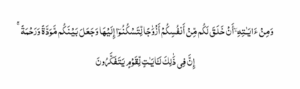
And from His divine signs (which are indicative of His oneness and power) is that he created for you spouses whom you find tranquility in, and He places between you and your spouse affection and loving kindness. Verily in that is certainly signs for the people who ponder. (Rum:21)
Allah Ta’ala has created men and women from the same matter, however there is a world of difference in their built, appearance, looks, character, habits, morals and temperaments etc. If one desires to recognise Allah Ta’ala , the creation of women provides an excellent example of His supreme power. The wisdom behind Allah Ta’ala creating women is:
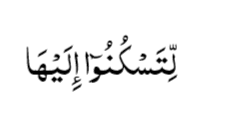
So that you may find tranquillity in them.
The ultimate requirement for men and women is to attain peace of mind, tranquillity and comfort which the Holy Quran has summarised in one word.
Peace of mind can be only achieved when mutual rights are recognized and a proportionate effort is made to fulfil them. Demanding our rights however, will result in conflicts and disputes arising. Knowing what is required of us (being aware of the consequences of our actions) and being sympathetic to the needs of our partners all contribute to the effort of making our marriages work. However, we have witnessed that people will only submit to laws provided there is taqwa (fear of Allah Ta’ala) in their hearts.
Mutual relations between husband and wife are so delicate that neither can any law ensure the fulfilment of their rights nor can any court do full justice to it. It is for this reason that Rasoolullah (Sallallahu Alayhi wa Sallam) had selected three verses in His Khutbah of Nikah, all which lay emphasis on Taqwa (of being accountable to Allah Ta’ala). It is only this quality of taqwa which will stand as a guarantor for the fulfilment of mutual rights.
Conjugal rights have been made for the emotional need of every man and woman.

And He has created love and kindness between you.
Here, Allah Ta’ala has not restricted the institution of marriage to a religious and legal relationship only but rather the words Mawaddah (love) and Rahmah (kindness) are used. It is possible that Mawaddah (love) refers to the young age where the spouses are attracted to one another with love and affection; whilst Rahmah (kindness) refers to the old age when passions subside and compassion for each other takes over.
(Mariful Quran 6/736)
Some Aspects Towards a Successful Marriage
- Salaah
This is the most important component after our Imaan. Hazrat Abu Umaamah (Radiyallahu Anhu) said, “When a person performs Wudhu correctly and then performs his Fard salaah, Allah Ta’ala forgives all his sins committed that day; by his feet in going towards evil, by his hands in doing evil, by his ears in listening to evil, by his eyes in looking at evil and by his heart in thinking evil.” He further added that he had heard this repeatedly from Rasoolullah (Sallallahu Alayhi wa Sallam) (Musnad Ahmad #22272).
In a tradition reported by Hazrat Nawfil bin Mu’aawiyah (Radiyallahu Anhu), Rasoolullah (Sallallahu Alayhi wa Sallam) has said; “A person who has missed one Salaah is like one who has lost all his family and wealth.” (Ibn Hibban:1468)
STRANGELY, WE HEAR OF THE WARNINGS REPEATEDLY BUT DO NOT TAKE HEED & MISS OUR SALAAH REPEATEDLY!
Hafiz lbn Hajar (Rahimahullah) writes, “A woman passed away. Her brother was present at her burial. By chance his purse fell into the grave and was buried with the dead body. The brother realized this after he had returned home and was distressed by the loss. He decided to dig up the grave secretly and remove the purse. When he dug up the grave, he saw the pit in flames. He returned home, grief stricken and related the story to his mother enquiring if she knew why this had happened. The mother informed him that his sister used to delay in Salaah and offered it after its fixed hours. (Fazaail A’maal, Virtues of Salaah pg.48)
- Commitment to The Quran
Regular recitation of Surah Yaseen will save the reciter from punishment in the grave.
It is mentioned in a Hadith narrated by Hazrat Abdullah bin Abbas (Radiyallahu Anhu) that: “He in whose heart there is no part of the Quran is like a deserted house.” (Tirmizi:2913)
Hazrat Abu Hurairah (Radiyallahu Anhu) says, “In the house where the Quran is read, the household members increase, virtues and blessings multiply, angels descend upon them and Shaitaan quits the house. Whereas the house where Quran is not recited, life becomes straitened and devoid of blessings, angels leave the house and Shaitaan ravages it.” (Ihyaa Uloomud Deen:Chapter regarding Quraan)
- Being Particular in Speech
Hazrat lmaam Abu Haneefa (Rahimahullah) has mentioned regarding the tongue, “Small in nature but big in problems.” Many of us are guilty of negligence with regard to what we say to one another.
Our Hazratjee, Moulana Muhammad Maseehullah Khan Sahib (Rahimahullah) advised us to weigh our words before speaking. Being contemplative before speaking is a sign of intelligence.
Hazrat Shafeequl Ummat, Moulana Muhammad Farouq Sahib (Rahimahullah) relates an incident of a lady who continually cursed her husband. It was a terrible habit. She used to say, “May your body come back home in pieces!” One day the husband
whilst on his way to work, slipped from the train and fell onto the tracks. His body was cut into pieces and brought home in a bag. The lady became insane when she witnessed the reality of her absurd utterances.
We have to bear in mind that in life, many things will go against our temperaments. We will certainly become angry but how we vent our frustrations is vital.
Hazrat Shafeequl Ummat (Rahimahullah) has shared a unique incident of a lady, who when her husband and members of the household upset her, she would use her anger as a catalyst for making good Duas in their favour. In this way her frustration was taken care of and the family benefitted from her anger! - Controlling Ones Anger
Our Hazratjee (Rahimahullah) always advised students and husbands in particular that when they go home, they must bring back anger with them. What will he do? He will slaughter anger. Presently, we use anger in the wrong avenues; when our family fails to perform any obligatory injunction of Deen, we do not even show any concern but if we suffer some material loss, we bellow like animals. Where are our values?
Imaam Ghazali (Rahimahullah) said that people say that they show anger towards their families for their own good but we should carefully examine if the tables were turned, would we want to be treated in the same manner?
Moulana Ismail Kathrada Saheb (Rahimahullah) has shared an example that if our wife was the sister of Mike Tyson, would we ever get angry? Even if we dare cast an angry glance at her, what will happen if the brother comes to know about it? In all probability, we will break the world record for the 100m sprint! The wife of My Beloved Mentor, Hazrat Moulana Hajee Muhammad Farouq Saheb (Rahimahullah) had said to those associated with Hazrat (Rahimahullah), “You have witnessed a small part of his life. In almost 30 years of marriage, never once did he raise his voice on me!!!” Subhaanallah! This is no fairy tale. Rather this is a reality that we should all endeavour to emulate. - Considering Our Manner of Admonishment
Many of us (both husbands and wives) go beyond the limits when rectifying one another. First rule, never criticize in public! Many husbands try to create the impression that they are the bosses but do not realize that they have dishonoured their wives by this humiliation. PRAISE IN PUBLIC and ADMONISH IN PRIVATE!
Our Hazratjee (Rahimahullah) gives an exquisite prescription for rectifying our wives. During the day, many different types of people came to the Khaankah for their problems to be addressed. The ladies would go to Ummijaan so that she could inform Hazratjee (Rahimahullah) of their issues and get his advices accordingly. When they were about to retire, the events of the day were discussed. Inadvertently, Ummijaan slipped into gheebat. Our Hazratjee (Rahimahullah) immediately stopped Ummijaan saying, “Stop! Stop! This will be categorized as Gheebat.” This is the manner and level of how we need to correct our wives. - Praise Each Other
Aarif Billah Hazrat Dr. Abdul Hayy Sahib (Rahimahullah) was once invited for meals at the home of one of his disciples. After partaking of the sumptuous meal, Hazrat Aarifi (Rahimahullah) praised the efforts of the lady of the house. To the amazement of Hazrat Aarifi (Rahimahullah), he heard the lady sobbing. He again reassured her that he thoroughly enjoyed the meal but the sobbing increased! After a few minutes, when the lady managed to control herself, Hazrat Aarifi (Rahimahullah) asked her if there was a problem. She replied; “Hazrat, you came today and had a meal for the first time yet you acknowledged the efforts that were made by me and showed gratitude. I have been married to my husband for over thirty years and not once did he ever acknowledge or praise my efforts. - Never Instruct
It was the noble habit of Aarif Billah, Hazrat Dr. Abdul Hayy Sahib (Rahimahullah) that he never instructed his wife for anything; even if it was for a glass of water. He was an embodiment of compassion and kindness which spontaneously led his wife to serve him enthusiastically. - Dress Up For One Another
It is essential that the husband and wife dress up for one another so that love increases. It is a common complaint from men that their wives remain untidy and unkept at home whereas when they leave the house, they take great care in making themselves attractive.
The women also complain that their husbands are shabby and untidy. As the husband and wife do not dress up for one another, the calamity of lustful glances has created havoc in our marriages.
Allamah Alusi (Rahimahullah) mentions that the command in the Quran,
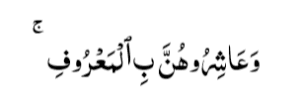
And live with them in kindness (Nisaa:19)
Means that a man should adorn and beautify himself for his wife just as she does for him. Both will obviously do so within the boundaries of the Shariah.
- Apportion Ownership of Items from Inception
Hakeemul Ummah Hazrat Moulana Ashraf Ali Thaanwi Sahib (Rahimahullah) has said that ownership of the contents of household items is essential in avoiding disputes. The Arabs are very careful about this and it is something that we need to implement in our lives. It has been mentioned that Hazrat Hakeemul Ummah (Rahimahullah) put all his possessions in a separate cupboard to avoid confusion and problems which may arise in the future.
Prior to Hazrat Mufti Muhammad Shafee Sahib (Rahimahullah) passing away, there were some kitchen utensils in his room and after using them insisted that they be taken away. The members of the family were surprised at the concern and urgency of removing the kitchen utensils. It eventually transpired that these were given to his wife and he did not want to keep someone else’s possessions with him. - Help With The Chores at Home
It is indeed a tragedy that we, as Muslims, have ignored and forgotten the noble Sunnah of assisting with the chores at home. We always expect to be served but have we considered our wives? The meal is painstakingly prepared by them and presented with compassion. We sit down and instruct our wives for every little thing. Our Noble Master (Sallallahu Alayhi wa Sallam) helped with the dishes at home, swept the floor and even mended his clothes. This is the prophetic prescription for happiness and understanding. Let us be honest with ourselves; do we, as men, even pick up the dirty dishes and put them into the sink? Have we assisted our wives in clearing up? Have we expressed gratitude for the meals cooked? Sayyiduna Rasoolullah (Sallallahu Alayhi wa Sallam) has shown us through his habits how to create an environment of caring and compassion at home.
The Hadith of Aisha (Radiyallahu Anhaa) mentions,
كان يكون في مهنة أهله، تعني خدمة أهله
Nabi (Sallallahu Alayhi wa Sallam) would be in the work of His family, meaning their service. (Adabul Mufrad:538, Tirmizi:2489)
Do we consider ourselves above the Sunnah? We need to rectify and adorn our habits with the Sunnah; when respect is shown towards the wife, she will most certainly reciprocate with showing respect.
Ten Acts of Foolishness
- One who does not perform good deeds but yearns for Jannah;
- One who remains unfaithful to others but expects loyalty from them;
- One who is lazy and idle and still expects his desires to be fulfilled;
- One who disrespects elders and expects the young to obey and respect him;
- One who does not abstain from harmful things in illness and still expects to recover? (Diabetic);
- One who spends more than his income and looks forward to luxury and prosperity;
- One who does not assist others in need but expects others to help him in difficult times;
- One who reveals a secret to someone and tells him/her to conceal it;
- One who feels that he commits sins a few times to abstain later (foolishness);
- A husband who constantly squabbles with his wife and expects peace at home.